The Origins of Human Spirituality: What I Learned at Mkhuzweni Rock

Cave drawings at Mkhuzweni Rock made by the San people in Eswatini approximately 1000 years ago (1 kya). These rock paintings were made with ochre and other materials (such as kaolin) appear to represent males hunters as well as prey animals and possibly cattle with themes such as life and death. Photograph: ©Steven Wade Adams, Eswatini, 2024
In the fall of 2024, I traveled with a group of photographers to Eswatini and South Africa. We spent time with sangomas, witnessed Zulu ceremonies, and explored an ancient landscape. We also met Bob Forrester, an archaeologist and anthropologist who has spent years tracking the origins of African shamanism and the roots of human spirituality. Bob is not shy about his views, and while I didn't fully appreciate it at the time, what he showed us would later change how I understand my own practice.
One morning he took us to Mkhuzweni Rock, a newly discovered site of San rock paintings in a part of Eswatini most people have never even heard of. We were the first to visit outside of the local village and the archaeological team. The local people named us Emahlahlandela, the first to come to Mkhuzweni Rock. There we stood in front of rock paintings made 1000 years ago, images of hunters, prey animals, cattle, and figures that could be human or could be something else.
Bob had been busy talking all morning about the origins of spiritual practice. (See: The Digging Stick April 2021). He described his belief that the spiritual impulse emerged alongside the expansion of human cognitive capacity and our ability to contemplate the past and the future. This was then followed by the evolved ability to explain the dream state and to assign meaning to what couldn't be seen or proven. Those who could interpret dreams and visions, he suggested, may have been the first shamans, people whose ability to navigate the boundary between the living world and the ancestor world gave them real social power within their communities.

A traditional healer in South Africa bridges the realms of the living and the deceased. Photograph: ©Steven Wade Adams, South Africa 2024
I was listening, taking photographs, and thinking this was extraordinary access. I'll have to write something about this. I was assembling an intellectual framework for what I was hearing as I had been taught through my academic and scientific training. But something else was beginning to take hold beneath that, which took longer to fully assimilate.
48,000 Years of Searching
The Lion Cave Mine in Eswatini has been mined for ochre for at least 48,000 years, making it among the oldest known mines in human history. Bob has spent a lot of his years thinking about what this actually means. He explained to us the central role of ochre in human spiritual practice. It has served as one of four means through which humans in Africa accessed the spirit world: dreams, trances, mind-altering substances, and the most readily available option, ochre.

Site of the The Lion Cave Mine in Eswatini that has been mined for ochre for at least 48,000 years Photograph: ©Steven Wade Adams, Eswatini, 2024
Ochre is still readily found in the open markets of Eswatini today. The same iron oxide, ranging from yellows to deep reds, that humans were using 48,000 years ago to paint their bodies, their cave walls, and use during burial rituals. This continuity of an unbroken line of human practice reaching back 48,000 years and still found in an open market in 2024 was suddenly profound.

Ochre (iron oxide) for sale in a market in Eswatini. Varying shades of red are sold that reflects the purity of the iron oxide within the mined material. Photograph: ©Steven Wade Adams, Eswatini, 2024
The Himba people of Angola and Namibia, whose ochre-covered skin and cattle-inspired adornments I photographed in 2022, are part of that same unbroken line. Their adornments are not decoration, but are a form of spiritual practice, a way of making the body a site of connection to the ancestor world. In these cultures, the cattle themselves are spiritual intermediaries in many traditions. The most sacred location in Eswatini today is amongst the royal cattle.

The Himba people of Northern Namibia and Angola use ochre liberally on their skin as a cosmetic and sun protection and many of their adornments are intended to resemble cattle which have spiritual significance to many of these tribes. Photograph: ©Steven Wade Adams, Angola, 2022
Bob noted there are recurring elements in shamanic practice across cultures that had no direct contact with one another, sacred water, fire, and smoke, ancestor communication, and the concept of two realms. His preferred explanation is that this is not a coincidence or independent invention but a result of a shared ancient origin. He concludes that when our ancestors left Africa, carrying their ochre and other symbols of spiritual practice, they also carried within them a universal and structural spiritual composition, something that could not be left behind because it was part of what they were at the most fundamental level.

Borana herding cattle during lush rainy season in northern Kenya. Photograph: ©Steven Wade Adams, Kenya 2024.
Why Dreams Matter
Early humans undoubtedly dreamt. And understanding what dreams were would have been deeply unsettling to them. Their first encounter with a second dimension entered involuntarily each night, where their dead ancestors likely appeared, probably fantastical creatures which acted with supernatural capacity, and the boundary between alive and not-alive became highly uncertain.
Those who could make some sense of this, who could articulate the dream, provide some interpretation and understanding of what it meant, would have held real power in the community. These may have been the first shamans who were recognized in the way communities generally recognize people who understand something that others do not.

Shamanic healing ritual in western Angola. Photograph: ©Steven Wade Adams, Angola 2022.
The previous year, in 2022, I had witnessed a rare healing ritual performed by a shaman of the Ovacuvale tribe. The connection became clear. Through the use of psychoactive agents, she had entered an alternate dream state for a purpose similar to what Bob had described for our earliest ancestors. She was fully interior, totally within herself as she performed this ancient ritual, wholly connected to her spiritual center.

A sangoma in Eswatini provides consulting for critical life decisions by communicating with the ancestors. Photograph: ©Steven Wade Adams, Eswatini 2024
The Living Evidence
I've been traveling and working in the field since I was in my twenties, across many countries in Asia, Africa, and Central and South America. I've waited in monastery corridors and healing ceremonies and pilgrimage routes for the moment the person in front of me forgets I am there. The moment when the performance ends and something underneath becomes briefly visible. I had always been drawn to the visual richness of devotional practice. The color, the ritual objects, the quality of light in sacred spaces. Yes, especially the light. All of that is real. But that doesn't explain the underlying reason.

Candles are commonly used to signify light from the spiritual world and/or light the way for the spirits. This image was taken after a consultation with a spiritual healer (Sangoma) in South Africa. Photograph: ©Steven Wade Adams, South Africa, 2024
Part of the reason I have finally understood is that what I keep searching for when I photograph is that moment of full interiority. This is not religion. It's what produces religion. It's the same motivation that produced these rock paintings. The same impulse that sent humans to the Lion Cave Mine 48,000 years ago, looking for a way to access something larger yet also quite private and structural. That is what I learned from Mkhuzweni Rock.

Dancing is one of many creative human activities with direct ties to spirituality. Photograph: ©Steven Wade Adams, South Africa , 2024
Bob categorized four possible explanations for why spiritual practice looks so similar across cultures that have never met. These could be a coincidence, genetics, environmental factors, or a shared ancient origin that evolved alongside human consciousness. The last is his favored explanation. Standing in front of 1000-year-old paintings in Eswatini with the ochre market an hour's drive away and a Sangoma session the following morning, this made total sense to me. It made sense that it was just something that exists within us as it came to be a part of the development of our unique brains.
What I Understood
Philosophers, anthropologists and theologians have been debating spirituality for centuries. This was then own path to understanding what it means to me, and by extension, to my practice of photography.
What was now clear is that spirituality is not a cultural phenomenon layered onto human experience. It is structural within our very composition. Our spiritual center is the place we retreat to when everything on the surface falls away. It has been present in the human brain for at least 48,000 years, and probably much longer. No prohibition or governmental mandate can reach it to snuff it out. No act of destruction, prejudice or war can destroy it. Because it is not borrowed from culture, training, religion, or circumstance. It is what we are as human beings.

Dancing Zulu maidens in Kwazulu-Natal participate in the annual traditional Reed Dance. Facial, hair and body adornments are a form of creativity that is found across cultures and is often provided spiritual meaning. Photograph: ©Steven Wade Adams, South Africa 2024
That's what Bob helped me to understand. It's what Mkhuzweni Rock was telling me as I sat in front of what was left behind by people who lived there 1000 years earlier.
I strive to photograph the moments when someone finds their interior place. When the surface falls away and what's underneath becomes briefly visible. When we are, however briefly, at our most essentially human. Aspiring toward something greater, more lasting, something that resists every attempt to explain it fully and control it.
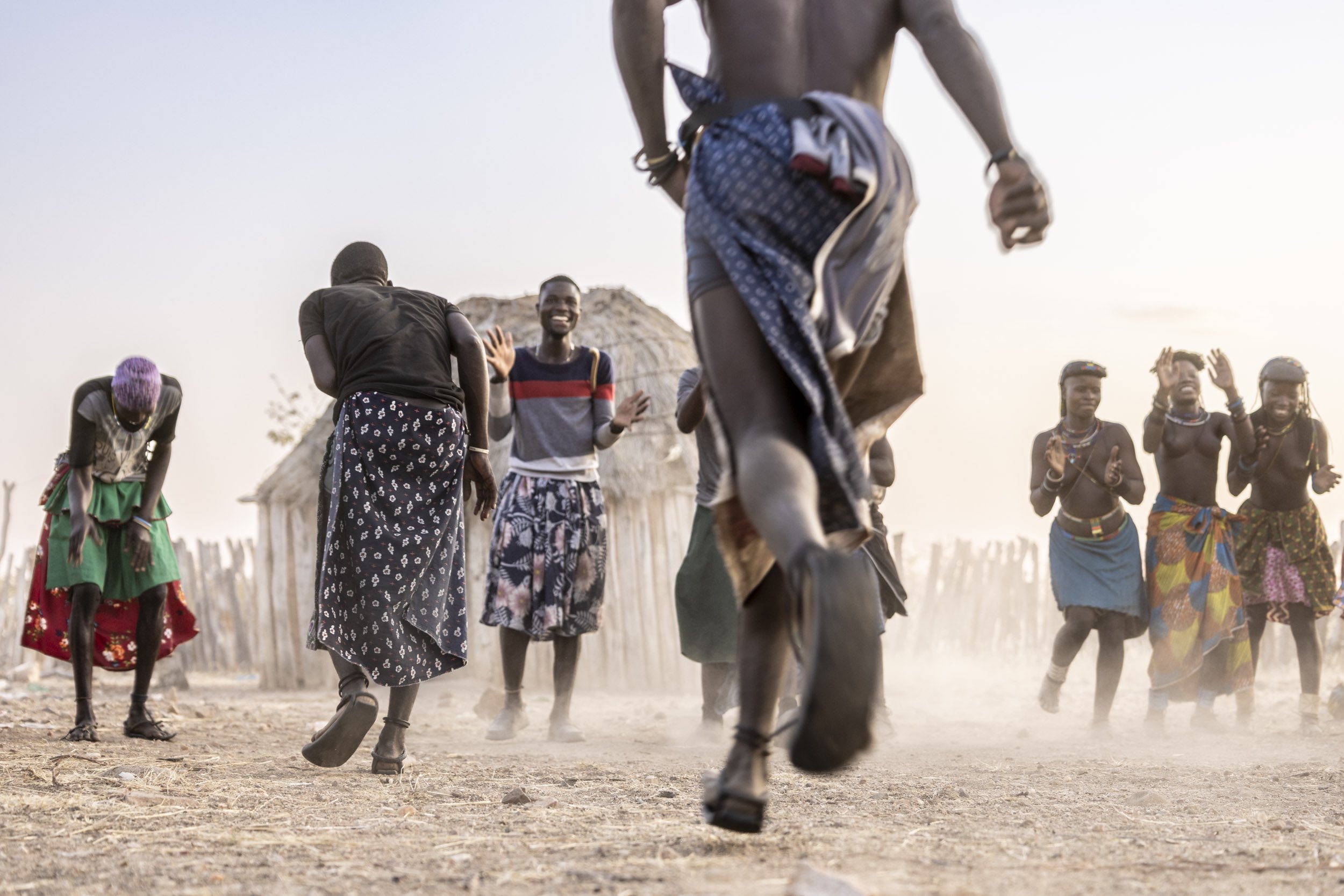
Music and dancing is a universal and uniquely human activity. Photograph: ©Steven Wade Adams, Angola, 2022