
The Strategic Clarity Gap: Why Excellent NGOs Miss Out on Major Funding
The Challenge
I was recently asked by a client to provide candid feedback on how clearly their strategic focus was coming across in their online presence. They wanted to get a better view of how funders and donors might perceive their communication efforts and ultimately their funding worthiness.

© 2023 Steven Wade Adams
A Framework for Assessing Strategic Clarity
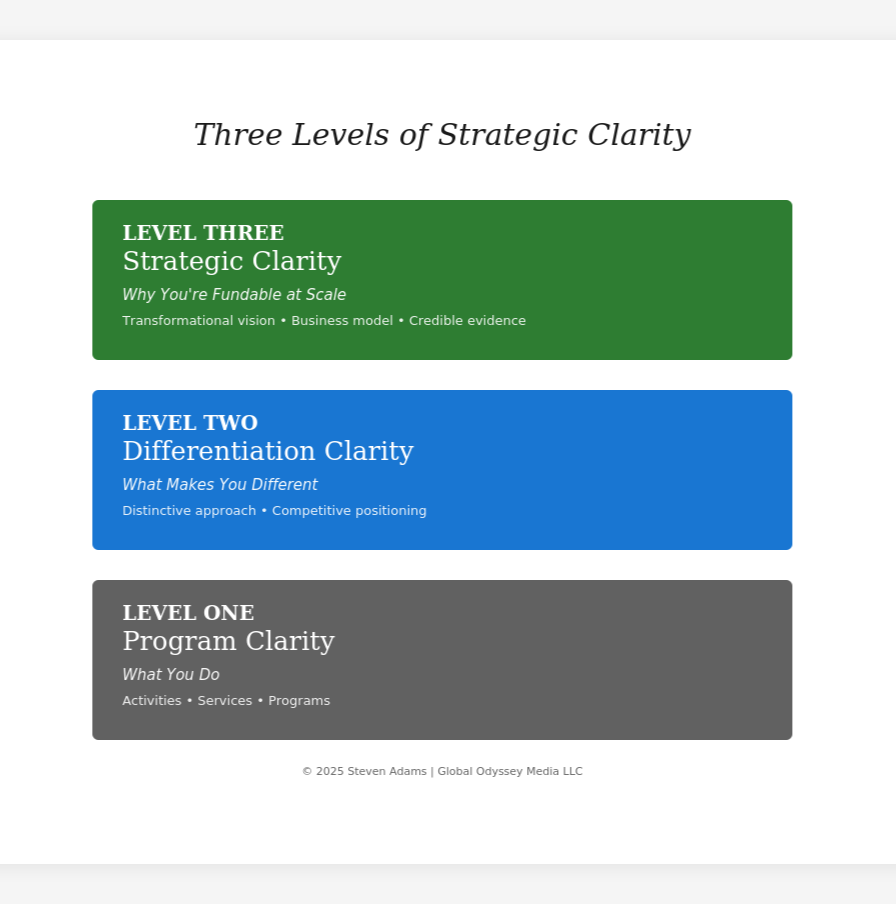
My first step was to apply the principles from several well-known strategic frameworks (See References below) into a collated version that I call the “Three Levels of Strategic Clarity” for Mission-Driven Organizations. I divide the characteristics into three simple levels.
Level 1: At this level, organizations can clearly describe their activities and services.
Level 2: At Level 2, they clearly articulate what sets them apart from others.
Level 3: At Level 3, organizations are strategically well-positioned, possess credible capability for growth, and articulate a clear, transformative vision. As I will demonstrate below, very few organizations actually operate at this level of strategic clarity.
My underlying belief is that organizations with well-articulated strategic clarity are better positioned to compete in a rapidly changing, highly competitive environment. This is especially critical for organizations with funding sources that are highly consolidated into one or a small number of sources. Several highly competent NGOs whose major source of support was USAID are now facing existential threats to their very existence after funding priorities shifted abruptly, and competition from other sources has intensified.
After developing complete definitions of these three levels of clarity as a basis for complex prompts, I asked three AI agents (GPT5.2, Gemini, and Claude) to analyze publicly available information on 20 major mission-driven organizations. Each agent assigned a cumulative “clarity” score between 1.0 and 3.0 to each organization. I then collated the outputs from the three agents and summarized the results, evaluating both the average score and the range between agents.
The conclusions were mostly consistent across agents, but in a few instances, there was greater divergence. After reviewing the websites of organizations with the highest divergence myself, I believe the agents’ scores seemed to vary more when the messages required more inference and interpretation. Other interesting correlations and observations emerged.
The Three Levels of Clarity: Why Most Organizations Cap at Level 2
Organizations may have spent 10-20 years building exceptional programs, creating solid data and impact data, while truly transforming beneficiaries' lives. Yet excellence alone doesn’t necessarily set you apart from your peers. The three levels were designed to differentiate among organizations in their effectiveness in articulating their strategy through public-facing documents, especially websites.
Level 1: Program Clarity (What You Do)
Every organization in the study achieved basic Level 1 clarity (although to varying degrees). This is, necessary but not sufficient. Examples of programmatic descriptions included phrases like "We provide primary healthcare in underserved communities” or "We deliver emergency food assistance in conflict zones" or “We train teachers and build schools." Not necessarily distinctive, but descriptive.
Level 2: Differentiation Clarity (What Makes You Different)
This is where organizations often get lost. They struggle to articulate what truly sets them apart from their peers and how they can stand out. They often use terms like "Evidence-based programming", "Systems-based approach", "Community-led development", and other sector jargon that are NOT real differentiators.
Most organizations in this study operate to some degree within Level 2. They have solid programs and impressive evidence with varying degrees of differentiation. Organizations operating solidly in Level 2 can readily answer "How are you actually different?"
Level 3: Strategic Clarity (Why You're Fundable at Scale)
This is where the real winners operate, as they can answer not only what they do and how they are different, but also “Why should someone invest $50 million in YOU to achieve transformational 2030 or 2035 goals?"
Level 3 integrates five dimensions or key questions:
1. Solid Level 2 differentiation: What makes you uniquely capable AND
2. Transformational Vision: What will be different by 2035? (specific, measurable BHAG).
3. Business Thinking: How can this be sustained beyond grants?
4. Credible Evidence: What exactly is the evidence that you can deliver?
5. Strategic Positioning: Why should funders choose you?
This isn't necessarily about improving programs (although that might also be needed). It's about articulating your strategy clearly to win the funding race and play an essential role in making a greater impact in the world.
This comparative analysis of 20 major organizations makes it clear what differentiates winners from losers in this segment of NGOs.
The Research Results: What Actually Drives Funding Decisions
Using the approach as described above, I applied these filters to 20 major international development and humanitarian organizations. These included billion-dollar financing mechanisms (Gavi, Global Fund), major implementing NGOs (Save the Children, CARE, Mercy Corps, IRC, Oxfam, and 12 others), a
nd UN agencies (UNICEF, UNHCR).
It's important to acknowledge that this analysis is based solely on publicly available communications, and the complex prompts presented to the AI agents were designed without third-party validation. Even with these biases and limitations, my goal was to provide my client with tools and an opportunity to challenge their own assumptions regarding brand and strategic clarity and encourage them to ask hard questions about their goals and direction. From this perspective, this effort was successful and represents an approach any organization can use to evaluate its own messaging, provided it devotes careful consideration to the follow-up questions it asks and is open to objectively responding to the results.
The findings from this study were rather stark. Only 15% of organizations assessed fully achieve what I call "Level 3 Strategic Clarity," the integration of five essential components that make organizations fundable at a transformational scale.
The other 85%, despite having excellent programs, decades of evidence, and strong brand recognition, struggle to operate beyond Level 2.
The Winners: Organizations with Exceptional Level 3 Clarity
I have not included the results of each organization here, but I am highlighting the noteworthy clarity that is articulated by a few of the very best organizations. The two top scorers are not traditional NGOs. Still, they are excellent examples of strategic clarity that is worth noting. Using the criteria developed for this study, they outperformed the other organizations in each dimension.
Gavi, the Vaccine Alliance (Score: 2.9/3.0)*
Transformational Vision Clearly Articulated: Vaccinate 500 million children, save 8-9 million lives, reach ZERO zero-dose children by 2030
Business Model: IFFIm innovative finance, market-shaping mechanisms, African Vaccine Manufacturing Accelerator
Credible Evidence: 1.2 billion children immunized, 20.6 million deaths prevented over 24 years
Result: $9 billion raised in 2025 replenishment
The Global Fund (Score: 2.8/3.0)*
Transformational Vision: Save 23 million lives, avert 400 million infections, reduce mortality 64% by 2029
Business Model: Financing mechanism, country co-financing, transition frameworks
Credible Evidence: 70 million lives saved since 2002
Strategic Positioning: $19 return per $1 invested
Result: $18 billion raised for 2027-2029
Save the Children (Score: 2.8/3.0)*
This is the only traditional NGO in this study that approached Level 3 strategic clarity.
Transformational Vision: THREE specific 2030 BHAGs: (1) ZERO preventable deaths under age 5, (2) ALL children learn, (3) NO tolerance for violence
Differentiation: Child rights positioning (founded Declaration of Rights of Child 1923), 105-year heritage
Credible Evidence: 113.6 million children reached, strongest brand recognition in the child-focused sector
Result: $2+ billion annual budget
What do these three organizations have in common? They all have Level 3 Clarity: including how they are strategically positioned, exactly what a $1 billion investment achieves by a specific point in time, and they provide credible evidence that they can deliver.
The Paradox: Excellent Organizations Losing the Race
UNICEF (Score: 2.2/3.0 Based on 2022-2025)*
Another observation worth noting is that, despite a superior mandate, a longer history, a broader reach, and greater brand recognition, UNICEF raises LESS per year than Gavi raises in a single campaign. This is likely related to their level of strategic clarity.
Gavi tells you precisely what $1 billion buys: 500 million children vaccinated, 8-9 million lives saved by 2030. UNICEF has five Goal Areas and 18 Result Areas, but no recognizable organizational BHAG that specifies what a $1 billion investment will achieve.
What's Missing: Transformational Vision
Several organizations state they have strategic plans and "Vision 2030" or "Our Promise 2030" strategies. However, having a strategic plan with a 2030 timeframe is NOT the same as articulating transformational outcomes. Many organizations in this cohort articulate a time bound goal that is intended to br inspirational, but often it is not very specific. In fact, a full 86% of organizations in this study lack a readily identifiable, specific, measurable BHAG in their public-facing materials. So it would seem that organizations articulate PHILOSOPHY beautifully but OUTCOMES rather vaguely.
It's understandable that competent organizations that have been very successful for years, perhaps decades, under a well-honed business model respond with “We don't need bold claims. Our programs are evidence-based, reaching millions, and genuinely transforming lives. Good work should speak for itself."
I recently watched an organization with a genuinely exciting, innovative program reluctantly articulate a specific BHAG, which was a critical factor in securing a multi-million-dollar seed investment. Sadly, once the funding was secured, their public-facing materials dropped all specific targets, timelines, and clarity about their revenue models. This may seem like a safe and responsible approach when the future is unknown. By disavowing key elements of Level 3, they are actively robbing themselves of strategic clarity and distinctive business advantage, characteristics essential for long-term success and impact.
I do not believe that funders are predisposed to investing in "good work" as an abstract concept. If BHAGs are unnecessary, then why do they work to capture interest and secure funding? It is because funders want results, so they invest in transformational outcomes with credible pathways and measurable timelines.
UNICEF is a good example where the argument that "good work speaks for itself" doesn’t quite hold up. While Jim Collins in Good to Great didn’t specifically call out nonprofits for lacking BHAGs, it makes sense that this concept applies to them as well as to for-profit companies, where the pattern was well documented. UNICEF has exceptional credentials, an official UN mandate, extraordinary evidence (75 years, millions of children), and a vast reach (190 countries). Despite all these advantages, UNICEF faces chronic underfunding compared to GAVI. A notable difference between these organizations is that UNICEF lacks a clear, visionary enterprise-level BHAG that articulates the transformational impact funders can rally behind. Historically, UNICEF has led with five Goal Areas (2022–2025) but no BHAG. I will note that the 2026–2029 plan introduces quantified ‘Impact Results’ that resemble BHAG-style targets, so this suggests it will be worthwhile to revisit this assessment in the future, as the addition of these targets does positively influence clarity.
Audit Your Current Level of Strategic Clarity
When you assess your own organization, can you clearly and confidently describe what you do? If yes, great, then you have baseline clarity, and you operate at Level 1.
Can you articulate what makes you truly different from competitors? If yes, excellent, then you are operating at Level 2. It’s essential to inject some caution here. It is very easy to say you are different. Proving you are different is yet another matter. This is where a mechanism to look at reality less emotionally is quite helpful. This could be acquired from impartial third-party reviewers. It is also an excellent application of AI agents that can collate and sort vast amounts of information and generate insights that are less subject to emotional interpretation. That said, this is only useful if you are willing to consider the feedback objectively.
To actually claim you are operating at Level 3, you must be able to answer these five questions completely:
1. What can you do that no competitor can replicate?
2. By 2030 (or another specific date), what specific, measurable transformation will you achieve for how many people where?
3. How is your work sustained beyond grant dependency?
4. Why should funders believe you can deliver? What is the evidence?
5. When funders have $50M to invest in 2030 goals, why should they choose you (beyond commoditized program delivery)?
Conclusion: What Clarity Brings
I am not claiming that clarity alone will guarantee funding success. It will not create interest in funding where none exists. It will not substitute for track record, capabilities that must be proven, or for strong relationships that take years to develop. It will, however, enable your organization to create positive first impressions, reduce confusion (both internally and externally), and provide a basis for differentiation guided by transformational vision. It just might be the foundational grounding necessary to reposition yourself from an entity on the brink of extinction to one that can thrive through crisis and actually emerge stronger to make an even greater impact in the world than you had ever imagined.
REFERENCES:
Jim Collins - Built to Last and Good to Great
Geoffrey Moore - Crossing the Chasm
Simon Sinek - Start with Why
Marty Neumeier - The Brand Gap
Al Ries & Jack Trout - Positioning: The Battle for Your Mind
*The scores assigned by AI agents for the levels of strategic clarity are based on specific, detailed, and potentially biased prompts that I created based on my interpretation of concepts presented in the works cited here. Modified prompts, weighting or even additional rounds of questioning would undoubtedly yield varying results.
Other related articles I will be publishing in this series:
AI and Nonprofits: Why Strategic Clarity Matters More Than Automation
Ethical Storytelling for NGOs: An Anthropological Approach to Strategic Communications
© 2025 Steven Wade Adams | Global Odyssey Media LLC